
If your jaw clicks every time you take a bite of a sandwich, yawn, or brush your teeth, you’re far from alone — and you’re not imagining it.
That click is almost always a sign that the small disc inside your jaw joint has shifted out of its normal position. The sound itself isn’t dangerous. But it does tell you the joint is working harder than it should, which can set the stage for pain, headaches, or jaw locking down the road.
Here’s what’s actually happening inside your jaw, who should pay closer attention, and when it’s time to see a clinician who understands the jaw joint.
What the click actually is
Your jaw joint — the temporomandibular joint, or TMJ — is one of the most used joints in your body. You use it every time you talk, chew, swallow, or yawn. Inside the joint sits a small cushioning disc that acts like a shock absorber between the ball of your lower jaw (the condyle) and the socket of your skull.
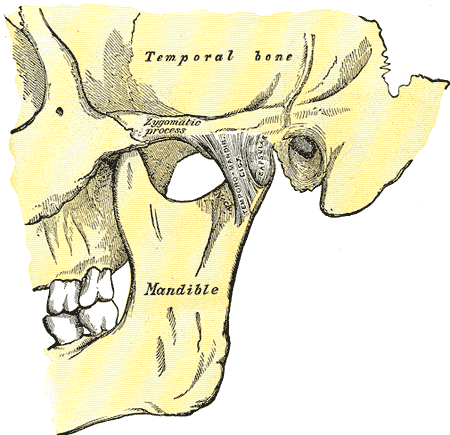
In a healthy joint, that disc stays nicely positioned between the two bones as your jaw opens and closes. In a jaw that clicks, the disc has slipped slightly forward when your mouth is closed. When you open your mouth, the condyle moves forward and “catches” the disc, snapping it back into position — and that snap is the sound you hear.
Clinicians call this anterior disc displacement with reduction. “Reduction” is the medical word for the disc getting recaptured during opening. If you hear a second click as you close your mouth, that’s the disc slipping back out of place.
How common is this?
More common than most people realize. Research published in the clinical dental literature suggests that disc displacement with reduction is present in roughly one in four adult jaw joints. The National Institute of Dental and Craniofacial Research (NIDCR) estimates that temporomandibular disorders overall affect between 5% and 12% of the adult population, and are at least twice as common in women as in men.
Most people with a clicking jaw never develop serious problems. But a meaningful minority do — and the earlier the pattern is caught, the easier it is to manage.
Who should pay closer attention
A clicking jaw by itself isn’t an emergency. But it deserves a closer look if any of these also apply to you:
- You get frequent headaches, especially in the temples or behind your eyes
- Your ears ache, feel full, or ring — and your doctor says your ears are fine
- Your jaw occasionally locks open or shut, even briefly
- You wake up with sore jaw muscles or you’ve been told you grind your teeth at night
- You’ve been in a car accident, a sports collision, or had a fall — even a minor one
- The clicking has gotten louder, more frequent, or started hurting
- One side of your face feels different from the other when you chew
These combinations suggest the joint mechanics are affecting more than just the joint itself. The muscles that control your jaw are connected to the muscles of your neck and the base of your skull — which is why a TMJ disorder so often shows up as a headache, an earache, or neck pain.
What you can do today
Some simple steps can take pressure off the joint while you figure out what’s going on:
- Soften your diet for a few days. Skip gum, chewy bread, tough meats, and anything that makes you open wide. Give the joint a chance to rest.
- Notice how you hold your jaw. Many people clench or press their teeth together without realizing it. The resting position is lips closed, teeth slightly apart, tongue gently touching the roof of the mouth.
- Apply moist heat to the jaw muscles. Fifteen minutes, two or three times a day, especially before bed.
- Watch your sleep position. Sleeping face-down forces the jaw sideways for hours. Try your back or side instead.
- If you grind at night, mention it to your dentist. A properly fitted night guard can reduce the load on the joint while you sort out the root cause.
When to see a clinician
See a clinician who understands jaw mechanics if:
- The clicking is accompanied by pain that lasts more than a week or two
- Your jaw locks (open or shut), even briefly
- You can’t open your mouth as wide as you used to
- Headaches or ear symptoms are affecting your sleep or your day
- You’ve already been evaluated by other providers and been told everything looks normal, but you still have symptoms
The last point matters. Standard imaging — a conventional X-ray or even an MRI — captures the joint at a single moment in time. But jaw problems are mechanical problems, and mechanics are about movement. Specialized motion imaging shows the joint as it actually works through its full range of motion, which can reveal patterns that a static image misses.
How we approach this at Jawmatrix
At Jawmatrix in Tarzana, every TMJ evaluation starts with a careful history and physical examination of how your jaw actually moves — not just how it looks in a snapshot. When appropriate, we use motion-based imaging to see the joint in action, so we can tell the difference between a joint that clicks but is otherwise stable and one that needs active intervention.
If your jaw clicks and you’ve been wondering whether it matters — it might, and it’s worth finding out while the pattern is still easy to influence.
Schedule an evaluation · 818-600-8188
18401 Burbank Blvd #107, Tarzana, CA 91356
This article is for general educational purposes and is not a substitute for an individualized clinical evaluation. If you have severe pain, your jaw is locked, or you cannot open your mouth, seek care promptly.